Proposals and client portals for professional services firms.
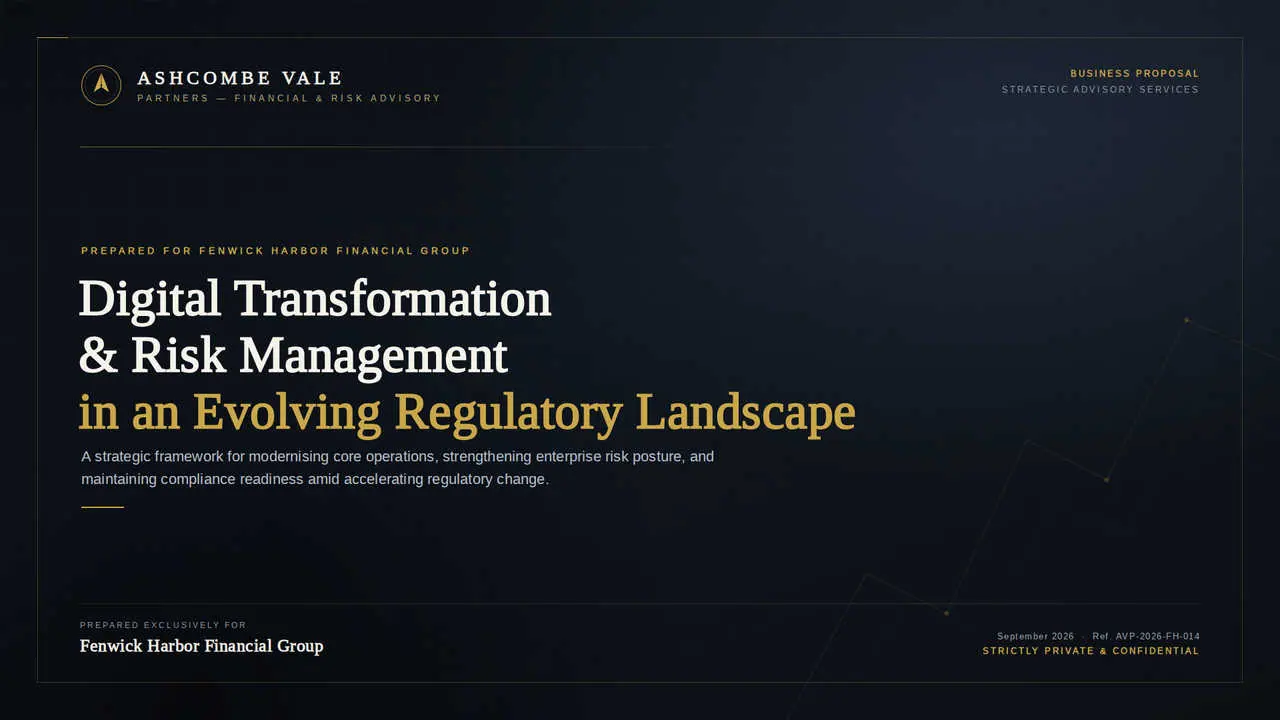
Business Proposals
Send proposals as trackable interactive links. Know when the partner or board opens them, which sections they spend time on, and capture approval inside the same document — no separate tools.
What you can build with Chalkroom.
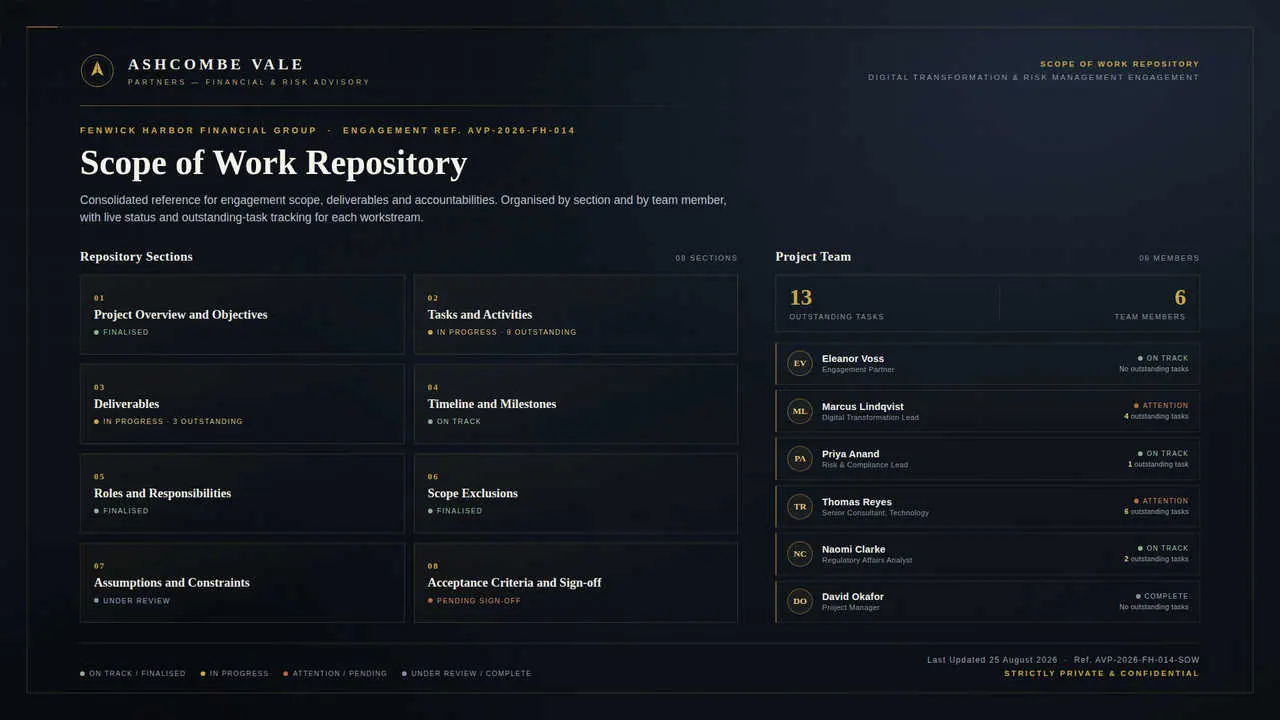
Scope of Work
Structured SOW documents with inline approval capture. No version disputes, no email threads — one link, one version, one record of what was agreed.
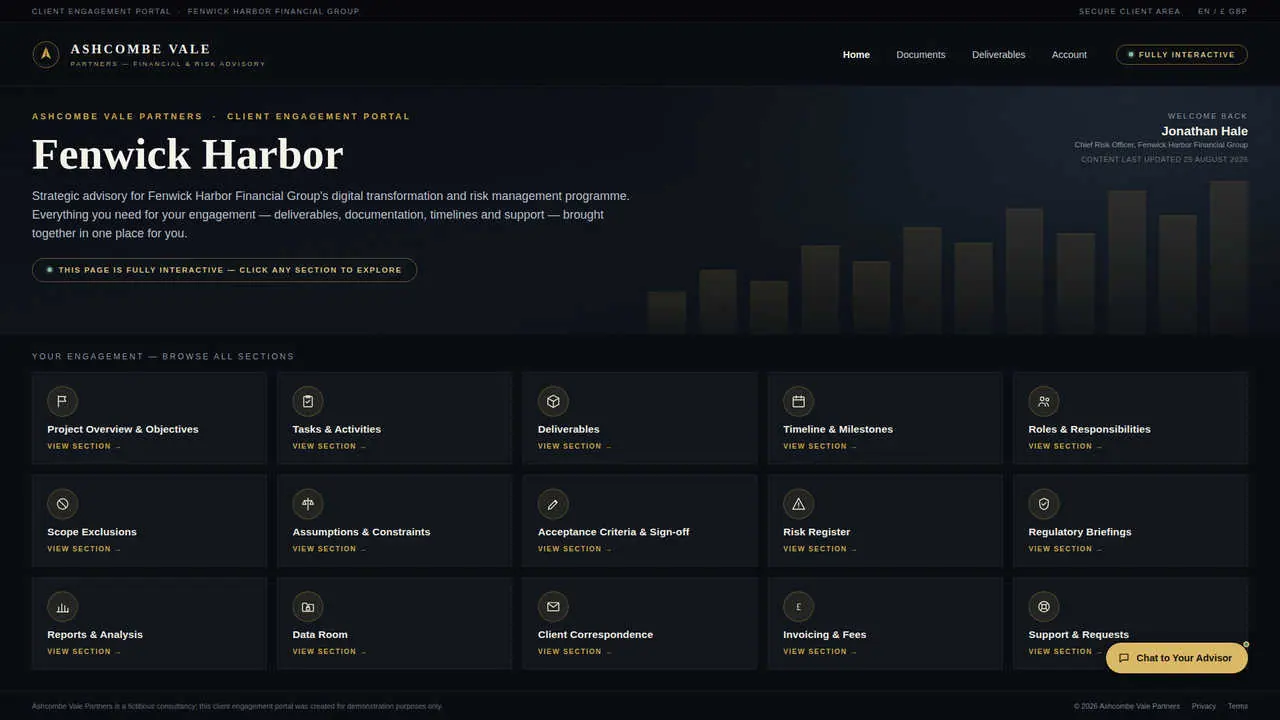
Client Portals
One permanent link per engagement — deliverables, progress updates, reports and approvals all in one place. Clients always know where to go; you always know what they've engaged with.
We understand your world.
Proposals sitting unread in procurement inboxes for weeks with no feedback signal
Outdated credentials being sent by different partners from different cached versions
Chasing sign-off and approval over endless email chains with no single source of truth
Client deliverables scattered across inboxes, shared drives and Slack threads
No record of which version of the SOW was presented, approved or later disputed
Scope creep beginning the moment the work order is ambiguous or sent as a flat PDF
Built for your workflow.
Proposal engagement tracking
See when the client opens your proposal, which sections they read and for how long — so follow-up conversations are informed rather than blind.
Interactive proposals
Proposals that embed case studies, team credentials and approval capture — not PDF attachments that arrive without context.
SOW with approval capture
One structured scope of work with digital sign-off built in. Clear, unambiguous, with a complete audit trail of what was agreed and when.
Client portals
A curated, branded portal per engagement — deliverables, reports and updates in one permanent, trackable link.
Credential governance
One approved library of case studies, team profiles and firm credentials — current across every partner and associate who sends proposals.
Engagement analytics
Track which parts of your proposals and deliverables clients engage with most — and use that data to improve your next pitch.
Common questions.
The most effective professional services proposals address five questions the client is actually asking:
- Do you understand our problem? — a crisp restatement of the challenge before any solution is proposed
- Why you? — relevant credentials, case studies and team experience specific to this engagement
- What will you do, and how? — methodology, workstream structure and key deliverables
- What will it cost and how long will it take? — fees, timeline and key assumptions
- How do we start? — a clear next step that removes friction from the approval decision
As professional services proposal software, Chalkroom's format doubles as a fee proposal template — structuring all five into a navigable interactive document, with per-section engagement data so you can see which part of the proposal the client spent most time on.
Scope creep usually starts with ambiguity at the point of sign-off. Three practices help:
- Structured SOW format — defined deliverables, explicit exclusions and clear acceptance criteria, not narrative prose
- Digital approval capture — one link, one approver, one timestamp. No 'I thought we agreed differently' debates
- Scope change workflow — a clear process for raising and approving changes against the original baseline
Chalkroom SOW documents cover all three — a consistent structure, built-in approval capture and a version trail that makes every change visible.
A scope of work is the document that prevents disputes — its job is to make the engagement explicit and unambiguous from day one. A robust SOW template covers six elements:
- Engagement overview — the purpose of the engagement and the problem it is addressing
- Deliverables — a specific list of what will be produced, in what format and to what standard
- Exclusions — what is explicitly not included, to prevent scope creep from ambiguous assumptions
- Timeline — key milestones, dependencies and the overall programme
- Fees and payment terms — total fee, payment schedule and conditions for variation or additional work
- Approval and sign-off — how deliverables will be reviewed and accepted, and who has authority to approve
Chalkroom SOW templates cover all six with digital approval capture built in — one link, one version, one undisputable record of what was agreed.
Winning business proposals share a common structure: they make it easy for the client to say yes. Five principles consistently separate strong proposals from average ones:
- Lead with their problem, not your credentials — clients want to know you understand their situation before they hear about you
- Be specific about what you will do — vague deliverable language signals risk; precision signals confidence
- Show relevant evidence — one strong, directly relevant case study outperforms five generic ones
- Make the commercial case clear — fees, timelines and assumptions stated plainly, not buried in appendices
- Remove friction from the next step — a clear CTA with digital acceptance built in closes the loop without a separate follow-up
Chalkroom's proposal format structures all five into a navigable interactive document — with per-section engagement tracking showing you which part of the proposal the client spent most time on.