Tender proposals and content for construction and engineering teams.
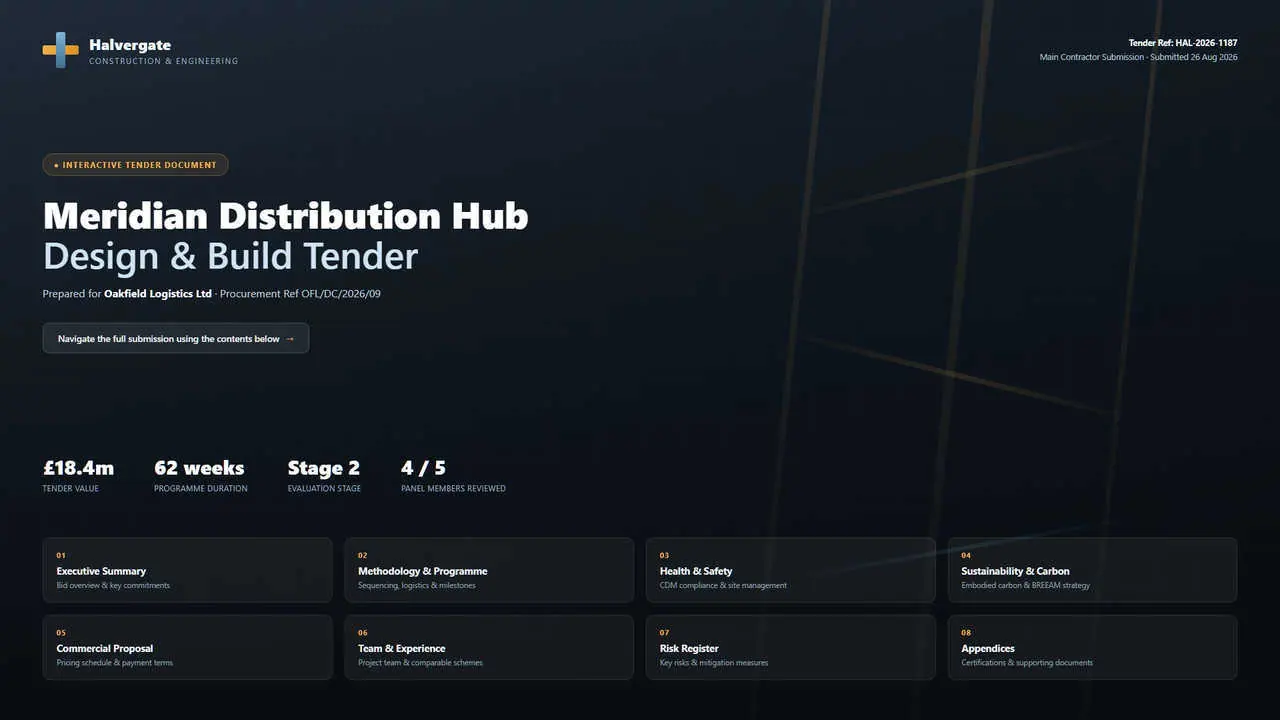
Tender Proposals
Structured, navigable bids that look significantly more professional than Word-to-PDF exports — with engagement tracking showing you when the evaluation panel reviewed the document.
What you can build with Chalkroom.
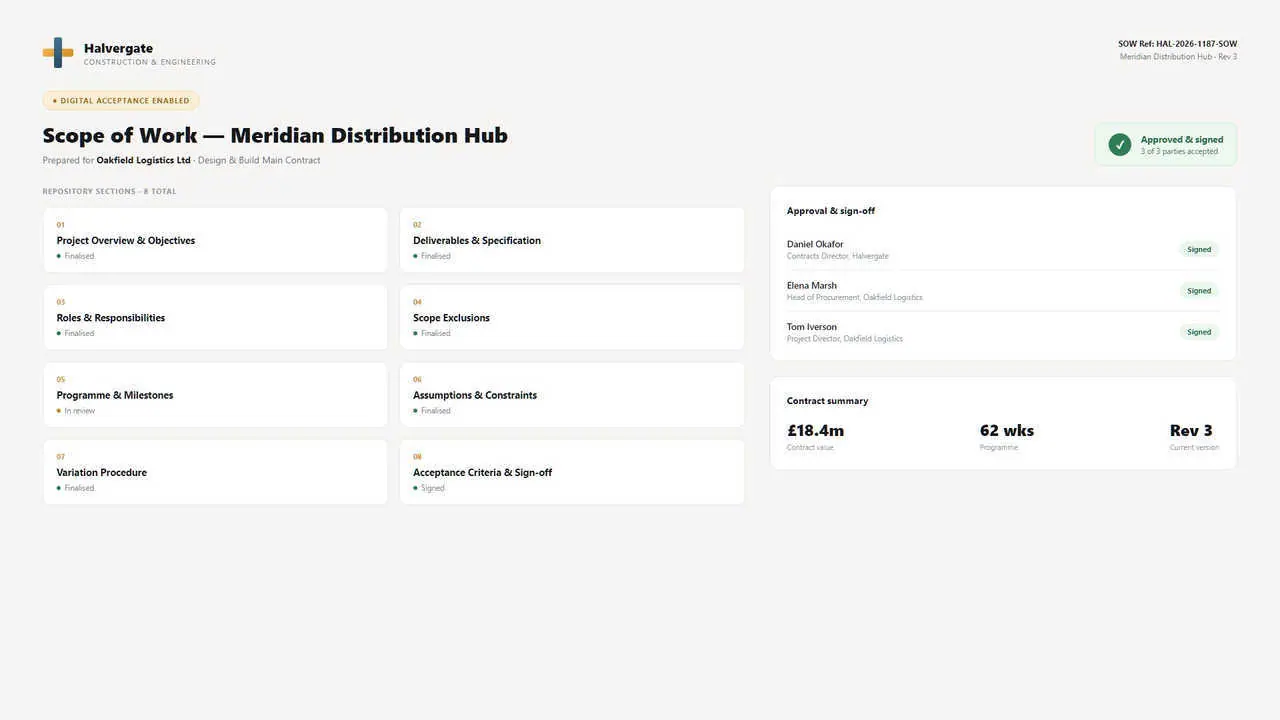
Scope of Work Documents
Clear, structured SOW documents with digital acceptance built in — one link, one version, one approval record. No scope disputes, no version confusion.
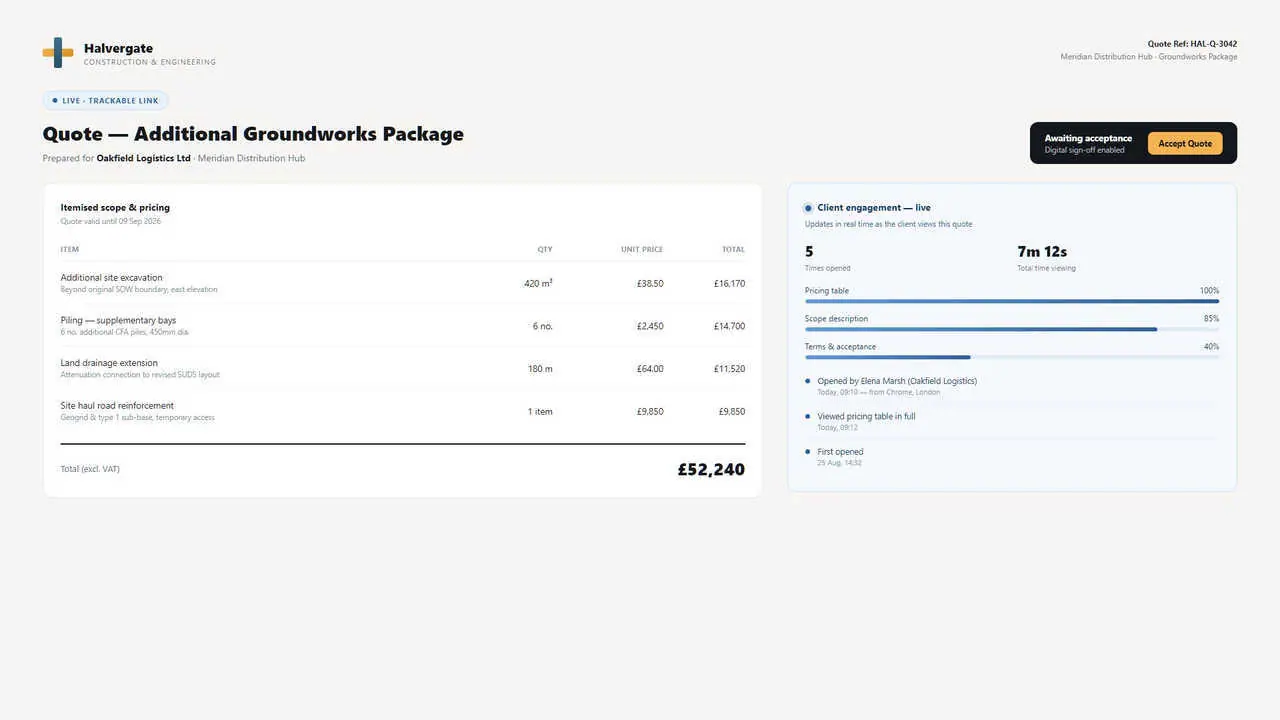
Quote Templates
Trackable quotes with itemised scope, pricing and digital acceptance — sent as a link rather than an attachment, with visibility into when the client opened it.
We understand your world.
Bids submitted as PDF bundles with no signal on how the evaluation panel engaged with them
Scope creep beginning with ambiguous or disputed scope of work documents
Different team members submitting different versions of practice credentials from inconsistent saves
Quote submissions sent by email with no clear record of when they were received or accepted
Pre-qualification questionnaires rebuilt from scratch for every tender rather than from a governed library
No feedback loop after unsuccessful tenders — no data to improve the next submission
Built for your workflow.
Submission engagement tracking
Know when the evaluation panel opens your tender and which sections they spent time on.
Interactive tender proposals
Structured bids that present methodology, credentials and pricing in a navigable format — not a PDF scroll that buries key information.
SOW with approval capture
Scope of work documents with digital sign-off built in — one link, one version, one undisputable record of what was agreed.
Governed credentials library
One approved library of case studies, project photography, team CVs and accreditation certificates — consistent across every bid the team submits.
Audit trail
A complete record of every tender, SOW and quote — who submitted it, when, and what was accepted.
Bid analytics
Aggregate engagement data across submitted tenders — informing which parts of your methodology and credentials are resonating with different client types.
Common questions.
A strong construction tender proposal covers five core areas that procurement teams evaluate:
- Executive summary — your understanding of the project and the client's objectives, in plain language
- Methodology statement — approach, programme and key risk mitigation, demonstrating competence without over-complexity
- Team credentials — relevant project experience with enough depth to be credible, not an exhaustive back-catalogue
- Pricing schedule — transparent, structured and easy for the panel to evaluate against competing bids
- Evidence of accreditations, health and safety record and financial standing
Chalkroom tender templates cover all five in a structured, navigable format — with engagement tracking so you know which sections the evaluation panel spent most time on.
Scope creep in construction almost always starts at the same point: an ambiguous or informally agreed scope of work. Three practices prevent it:
- Structured SOW format — defined deliverables per workstream, explicit exclusions, and clear client approval responsibilities
- Digital acceptance — one link, one approver, one timestamp. The signed scope is the baseline; any change must be raised as a formal variation
- Version control — every change to scope is tracked against the original, with a full audit trail of what was agreed, when and by whom
Chalkroom SOW documents cover all three. The digital acceptance workflow eliminates the 'I thought we agreed' conversations that generate most construction disputes.
A construction quote is a commercial commitment — its structure needs to be clear enough that both parties understand exactly what is and is not covered before any work starts. An effective construction quote template includes:
- Project description — a clear statement of the work being quoted, with reference to the specification or drawings
- Scope inclusions — itemised list of what is included in the price, with enough specificity to prevent later disputes
- Scope exclusions — what is explicitly not included, covering provisional sums, specialist items or third-party services
- Pricing breakdown — labour, materials and preliminaries separated where relevant, with a clear total
- Programme — start date, duration and key milestones, including dependencies on client or other trades
- Acceptance mechanism — how the client confirms acceptance, with a clear expiry date for the quoted price
Chalkroom quote templates cover all six with digital acceptance built in — one link, one record, no ambiguity about what was agreed.
A construction scope of work is the document that prevents disputes — ambiguity at this stage typically surfaces as cost and programme conflict during the works. A robust construction SOW template covers:
- Works description — a specific, referenced description of the scope tied to drawings, specifications or schedules
- Deliverables and standards — what will be built or installed, to what standard and with what materials
- Programme obligations — start date, duration, phasing and key milestones with float assumptions stated
- Client-supplied items — what the client is responsible for providing, by when and to what condition
- Exclusions — what is explicitly not included: specialist subcontracts, statutory fees, abnormal ground conditions, etc.
- Variation procedure — how additional work will be instructed, priced and approved
Chalkroom SOW templates for construction teams include digital approval capture — one link, one signed version, one baseline for any future variation conversation.